Report

Savant 2026 Trends Report

Agentic Automation in Finance, Tax, and Accounting
Table of Contents
Finance Leaders Weighed In on Agentic Automation.

Read the insights in Savant's 2026 Trends Report.

Executive Summary

The Strategic Context: Efficiency Mandate and Governance Gap

Enterprise Finance, Tax, and Accounting functions are entering 2026 under an uncompromising, shared mandate: deliver faster, higher-quality outcomes without increasing headcount. Agentic AI (autonomous agents executing workflows) has moved from experimentation to strategic necessity, yet most organizations remain trapped between ambition and execution.

The research reveals a structural gap between aspiration and readiness. Leaders expect transformational impact from AI, but execution is constrained by governance gaps, ERP integration complexity, and fragmented operating models. ‘Speed & efficiency’ stands out as the primary value driver, while governance, integration, and skills shortages are the principal barriers to AI adoption.

The prevalent posture among executives is to regard agentic AI and automation as an ‘opportunistic’ strategy, preferring to pursue isolated use cases instead of a well-thought-out, governed enterprise roadmap. Finance, Tax, and Accounting leaders know AI can transform the operating model, yet the majority are trying to scale transformation with pilot-level governance.

If enterprises are to enjoy the benefits of agentic AI and automation in 2026, their strategy must match the ambition. Organizations that align strategy, governance, and execution will accelerate ahead, while those that remain in pilot mode risk stagnation.

The message is simple: Now is the time to fully embrace agentic AI — 2026 will not reward cautious pilots disguised as strategy. 

Trends Analysis

Strategic and External Environment

The Savant 2026 Trends Report surveyed Finance, Tax, and Accounting leaders on a wide range of topics on the economy, global and domestic tax dynamics, political and regulatory influences, and environmental policies.

Economic and tax volatility dominate the external environment. The data reflects that the narrative is not uniform across the enterprise. Different departments interpret ‘pressure’ differently, and that divergence is shaping what gets funded.

External Forces Impacting Financial, Tax & Accounting

The data also reveals some expected variances across Accounting, Tax, and Finance Operations. For Accounting leaders, inflation, interest rates, volatile earnings, and FX pressures are viewed as the primary drivers of increased workload and risk, followed by international tax and regulatory complexity.

For Tax leaders, cross-border regulations, global minimum tax, transfer pricing, and multi-jurisdiction compliance outranked concerns about macro-economic conditions and planning uncertainty. All leaders across Finance Operations, Tax, and Accounting weighted ESG reporting as a lower-impact priority compared to core financial and compliance challenges.

You’re viewing a limited preview of this report.
Fill up the form to view the full report and get a downloadable copy in your inbox.

State of AI Adoption

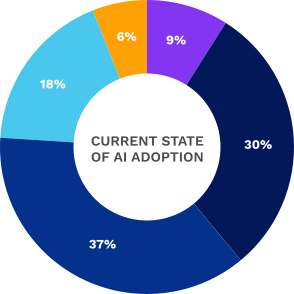
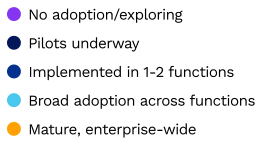
The market for agentic AI and automation is past the ‘should we’ stage. 67% of respondents report pilots underway or implementations in one to two functions. However, mature enterprise-wide adoption remains rare. Only 6% of Finance leaders report high levels of maturity.

Leaders overwhelmingly view agentic AI as a mechanism to increase throughput and decision quality without expanding headcount, but pursue transformational outcomes with tactical operating models.

Across all three functions, none are truly strategic at scale. Agentic AI and automation maturity is uneven across functions, creating fragmentation risk at the enterprise level, with early projects being driven by tactical use cases rather than a thoughtful strategic architecture.

An ‘opportunistic’ strategy equals enterprise pilot purgatory.

Functional Variations

Functional analysis reveals uneven maturity levels. Tax is the most exposed function with the highest regulatory, audit, and compliance risk, yet it is also the least strategic, making AI decisions on a case-by-case basis without a plan.

Range of Adoption
AI Adoption Strategy by Department

Accounting demonstrates the most structured approach, with nearly half the leaders moving beyond experimentation to a roadmap. The research confirms that Accounting leaders are quietly moving to become the de facto AI transformation engine of the enterprise.

Finance Operations teams exhibit high ambition but require greater discipline. Qualitative responses from leaders cite rampant growth of disconnected or rogue AI tools, duplicative workflows, governance crises, and shadow automation, all of which impede a clear, structured approach to agentic AI and automation adoption.

Tax operates under the highest regulatory scrutiny while having the narrowest margin for experimentation, making leaders inherently cautious in adopting agentic AI despite its potential strategic value. Unlike their Finance and Accounting peers, Tax leaders focus on minimizing risk rather than maximizing strategic upside.

The analysis makes clear that adoption of agentic AI remains tactical, creating limited adoption, non-strategic initiatives, and unmanaged risk instead of coordinated finance transformation.

Tax has the most to gain from agentic AI, but the greatest fear of getting it wrong.

Implementation Barriers

Executives in this study overwhelmingly cite ‘data governance and security’ (37%) and ‘integration with ERP/legacy systems’ (24%) as the primary barriers to scaling agentic AI and automation, documenting concerns that autonomous systems introduce errors, obscure decision logic, or compromise sensitive financial data.

This could potentially create downstream impacts on compliance, audits, and financial reporting. In short, the respondents are frozen, weighing whether the risks outweigh the potential gains.

Other qualitative responses underscored this trepid posture, with leaders viewing governance as a downstream implementation detail when, in fact, it is the primary gate to AI adoption and transformation within their departments.

ERP integration challenges outweigh concerns about the cost of AI (18%) and lack of skills (15%). Regardless of platform (SAP, Oracle, NetSuite, Workday, Microsoft, or others), leaders view integration complexity as a major obstacle.

In short, governance and ERP integration are the biggest hurdles currently preventing greater AI advancement within organizations. Leaders want AI and agentic automation that can run inside their finance teams’ realities: access control, lineage, approvals, evidence, and integration into systems of record (ERP, close tooling, tax systems, document repositories, etc.), but fears around auditability and controls prevent faster progress.

Governance is not the cost of AI adoption — it is the prerequisite.

Team and Use Case Prioritization

Finance Operations (33%) emerges as the leading entry point for agentic AI, reflecting its high-volume, high-frequency, repetitive, and rules-based processes that serve as prime candidates for workflow automation. Leaders suggested forecasting and scenario modeling, cloud cost allocation, spend anomaly detection, budget vs. actual optimization, and chargeback/showback as the top priority use cases for automation pilots and projects.

First Functions to Pilot AI Agents

FP&A (24%) and Tax (21%) are the next most popular functions projected to use agentic AI and automation for better insights, forecasting, and strategic decision support. The ranking for Tax indicates a focus on automating compliance, data extraction, and handling regulatory complexity.

Accounting/Close (18%) received the lowest preference among the primary functions, suggesting that while these functions hold immense potential for automation, organizations may perceive the risks of disruption to core financial controls and reporting accuracy as too high for a first pilot, preferring to stabilize operational areas first.

Financial Operations and FP&A are the most ready and willing to implement agentic AI and automation across a range of use cases, the results of which would accelerate other cross-department adoption.

Outcome Expectations

‘Speed & efficiency’ is overwhelmingly the top-ranked expected benefit, indicating that the immediate and most critical objective for adopting AI and automation is streamlining processes and accelerating operational performance.

‘Better insights & decision quality’ emerges as second, signaling a shift from automation toward cognitive augmentation.

Expected Benefits From Agentic Automation

While ‘speed & efficiency’ is the major expected benefit across all departments, there is some divergence between functions regarding benefits and value.

Departmental Variance on Benefits

The Finance function ranks ‘freeing staff for strategic work’ far higher than other functions, indicating that these leaders expect role elevation sooner, while Tax and Accounting leaders expect automation to intensify compliance and controls rather than create capacity.

Accounting executives rank ‘better insights and decision quality’ much higher than those in Finance and Tax, pointing to the prioritization of accuracy, visibility, and integration over efficiency gains for Accounting.

With a risk prevention mindset, Tax leaders see the benefits of AI through the lens of auditability, defensibility, and regulatory exposure.

None of the departments ranked ‘cost reduction’ as a primary benefit, implying that cost savings is an expected outcome, not an adoption driver. ‘Employee experience’ ranked last across every function. Despite all the media commentary about AI and workforce transformation, leaders do not justify AI investment and adoption on the basis of employee experience.

Opportunity Outlook

2026 Executive Themes

Looking ahead, leaders are clearly shifting their view of agentic AI and automation from a tactical efficiency initiative to a strategic transformation engine.

34% of respondents identify ‘strategic shift and value-add’ as the primary opportunity for the use of AI and automation, outpacing traditional drivers like ‘efficiency and process improvement’ (30%) and ‘cost and scaling’ (9%). This marks a pivotal inflection point: organizations are moving beyond basic automation towards AI agents that reshape decision making, operating models, and competitive advantage.

Top Executive Themes for AI in 2026

While process improvement remains critical, the rising emphasis on autonomous agents signals a deeper evolution in how value is created across finance organizations.

Investment Strategies

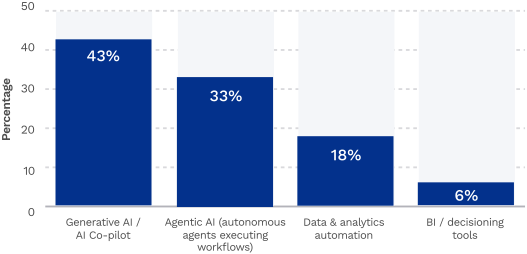
‘Generative AI/AI co-pilots’ (including LLMs) and ‘agentic AI’ together account for 76% of all leadership responses, clearly demonstrating that advanced AI is viewed as the primary target for investment, disruption, and value in 2026.

Area of Investment

Traditional ‘data and analytics automation’ (18%) and ‘BI/decisioning tools’ (6%) lag significantly behind, hinting at the industry’s focus on shifting from simply automating existing data processes to leveraging intelligent, cognitive agentic capabilities.

Workforce Strategies

The workforce story is not ‘AI replaces people.’ It is ‘AI raises expectations.’ 82% of leaders expect no net change in headcount driven by AI in 2026. AI is viewed primarily as a productivity multiplier rather than a downsizing mechanism.

15% of respondents anticipate targeted reductions in manual or repetitive roles, and just 3% expect net job growth in 2026, implying leaders are focused on efficiency before expansion, which will trigger the acceleration of agentic AI, automation pilots and proofs of concept.

Impact of AI and Agents on Headcount

The significant transformation is a shift in skill requirements and performance expectations. Organizations anticipate higher leverage per role, greater demand for analytical judgment, and increased cross-functional fluency.

An overwhelming majority of respondents consider AI’s role in workforce upskilling to be either critical (41%) or important (35%), suggesting that most functions recognize the necessity of adapting their workforce skills to the agentic AI and automation era.

Importance of Upskilling Workers with AI Expertise

Just 3% of responses saying ‘not important’ makes it clear that the functions have broadly accepted that AI is a permanent and significant factor in their talent development plans for 2026.

Implications and Recommendations

The Savant 2026 Trends Report on Agentic AI in Finance, Tax, and Accounting reveals a critical structural gap between high ambition and constrained execution. Enterprise finance functions are operating under a shared mandate for faster, higher-quality outcomes without increasing headcount, pushing agentic AI from an experiment to a strategic necessity. However, despite leaders’ expectations of transformational impact, execution is hindered by significant barriers — primarily governance gaps, complex ERP integrations, and a preference for pursuing isolated, opportunistic use cases rather than a well-governed, enterprise-wide roadmap.

This report’s core message is that strategy must align with ambition, urging executives to accelerate deployment beyond cautious pilots to avoid a structural business disadvantage.

Analysis of AI adoption shows uneven maturity across functions. Accounting demonstrates the most structured approach and is quietly becoming the de facto transformation engine. Tax is the most exposed to risk, yet the least strategic in its approach to AI, relying on case-by-case decisions driven by an inherent caution to minimize risk. Finance emerges as the leading entry point for pilots due to the high volume of repetitive processes it entails.

The primary expected benefit for all departments is overwhelmingly ‘speed and efficiency’, followed by ‘better insights and decision quality’, while ‘cost reduction’ and ‘employee experience’ are secondary motivations. Overcoming the main implementation hurdles — governance and ERP integration — is identified as the prerequisite for greater AI advancement.

The outlook signals a pivotal shift from tactical efficiency to agentic AI and automation as a strategic transformation engine, with generative AI and autonomous agents representing three-quarters of all investment focus. The workforce strategy is framed around ‘AI raises expectations’ rather than ‘AI replaces people,’ with over 80% of leaders expecting no net change in headcount and a strong focus on upskilling.

To drive this transformation, the report provides five immediate recommendations for 2026:

Agentic AI and automation are more of an operating model challenge than a technology challenge. Enterprises that align functions, modernize governance, and scale execution will redefine the future of finance. Those that do not will increasingly compete at a structural disadvantage.

Enterprises won’t lose to AI — they’ll lose to organizations that scale it faster.

Research Methodology

Savant conducted a structured sixty-day research program with an independent third-party research firm, engaging senior Finance, Tax, and Accounting leaders (Director level and above) across North American enterprises with more than 500 employees. The study combined quantitative surveys with qualitative executive surveys and interviews across 22 industries.

Data was anonymized, normalized, and segmented by function, industry, and organizational characteristics to identify statistically relevant patterns and functional variances. This approach enabled the identification of emerging signals, cross-functional divergences, and strategic implications.

Download Savant's 2026 Trends Report

Benchmark agentic AI adoption, priorities, and blockers across Finance, Tax, and Accounting

Download the Report

What Finance Teams Are Getting Right — and Wrong — About AI

How Finance Leaders Are Scaling AI in 2026

AI in Finance, Tax and Accounting is moving beyond experimentation into measurable operational impact. The Savant 2026 Trends Report explores how enterprise finance leaders are deploying AI automation and agentic workflows to increase speed, strengthen governance, and unlock strategic capacity across the enterprise. Drawing on market data, this report details current trends, strategies and expectations shared by leading enterprise executives.


Inside the Report:

  • State of AI in Finance Today
    Key trends shaping 2026 priorities, investment focus, and executive concerns across finance, tax, and accounting.
  • Teams and Use Cases
    Which departments are adopting AI automation and the functions most ready for deployment.
  • Barriers and Expected Outcomes
    Why governance and ERP integration constrain progress — and what leaders expect automation to deliver in 2026.

Download Your Report

Get Insights from Data in Minutes, Not Months

Work with tool stacks that expand your ability to deliver transformative analytics. Refresh, process, and manage data seamlessly to automate decision-making at the speed of your thoughts.